
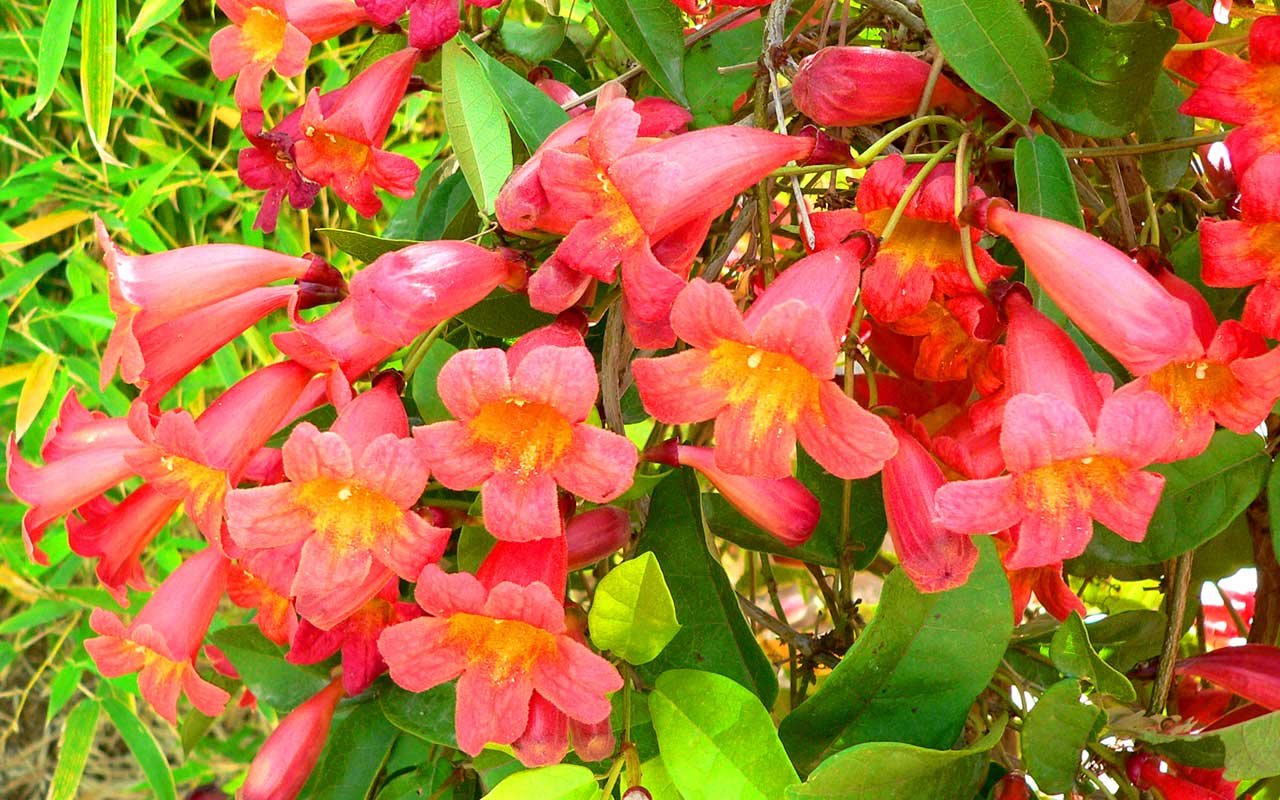
The crossvine plant, Bignonia capreolata, is a woody perennial vine grown for its tubular orange, red, and yellow flowers and semi-evergreen foliage. Give it good support, well-drained soil, and more sun for heavier flowering.
TL;DR
- Crossvine is a fast-growing woody vine that can climb 30 to 50 feet in suitable conditions.
- It grows in full sun to shade, but more sunlight usually means more flowers.
- Keep the soil well drained and water during dry periods, especially while the plant is getting established.
- Crossvine climbs with branched tendrils, so it needs a sturdy structure that gives those tendrils something to grip.
- Prune after flowering when you need to control its size or remove unwanted growth.
What is a crossvine plant?
The crossvine plant is a perennial woody vine in the Bignoniaceae family. Its botanical name is Bignonia capreolata, and it is native to the southeastern and south-central United States.
The common name comes from the cross-shaped pattern visible in a cut stem. Crossvine has opposite leaves made of two leaflets plus a branched tendril, which helps it climb fences, trees, trellises, and other supports.
The vine can reach about 30 to 50 feet long in suitable conditions. It is evergreen or semi-evergreen depending on climate, with colder areas more likely to see winter leaf color changes or some leaf loss.
Crossvine flowers are tubular and usually appear in shades of orange, red, and yellow. The flowers are especially useful in a wildlife garden because they attract hummingbirds and other pollinators.
How do you grow a crossvine plant?
Crossvine grows best in well-drained soil with regular moisture while young and enough sunlight for good flowering. It tolerates a broad range of conditions, including partial shade, but flowering is usually stronger when the vine receives more direct sun.
| Growing need | Crossvine requirement |
|---|---|
| Light | Full sun to partial shade |
| Soil | Well-drained soil with organic matter |
| Water | Moderate moisture, with better drought tolerance after establishment |
| Support | A sturdy fence, trellis, arbor, or similar structure |
| Growth | Fast in favorable conditions |
| Mature size | About 30 to 50 feet long |
North Carolina State Extension lists crossvine for USDA hardiness zones 5a through 9b and notes that it tolerates shade, full sun, and several soil conditions. Local climate and winter exposure still affect how much foliage remains through the colder months.
Choose the planting site carefully. A young vine may look modest at first, but crossvine can cover a large support as it matures.
How much sun does crossvine need?
Crossvine grows in full sun, partial shade, and even fairly shady conditions, but give it more sun if flowers are your main goal. A site with several hours of direct sunlight is a better choice for heavy flowering than deep shade.
Clemson Extension notes that crossvine flowers well in both full sun and part shade. North Carolina State Extension also reports better flower production with greater sunlight.
In a warm climate, some afternoon shade can help reduce heat stress. In a cooler or darker site, expect fewer flowers.
A simple test is to watch the planting area through the day before planting. If the site gets direct sun for much of the morning and early afternoon, it can be a good location for crossvine.
How should you water crossvine?
Water a newly planted crossvine regularly enough to keep the root area from drying out completely. Once established, the vine can handle periods of dry weather better, but it grows best when the soil has consistent moisture without staying waterlogged.
Check the soil before watering rather than following a fixed weekly schedule. Sandy soil may dry faster than a loamy soil, while heavy wet soil can hold water for too long.
Mulch around the root zone can help slow moisture loss. Keep mulch away from direct contact with the vine’s stems.
Crossvine also tolerates moist sites, provided drainage is suitable. North Carolina State Extension lists the plant as tolerant of moist, occasionally wet, and occasionally dry conditions.
What support does crossvine need?

Crossvine needs a strong support because mature vines can become large and heavy. A fence, arbor, trellis, or other sturdy structure works well.
Crossvine uses branched tendrils to climb. North Carolina State Extension explains that these tendrils wrap around narrow supports, while larger vines can climb trees and other structures.
Give the young stems something they can grip as they grow. A support with wire, narrow bars, or other suitable surfaces works better than a completely smooth, broad surface.
Plan for the mature size before planting. A small trellis that looks suitable for a young vine may become inadequate after a few growing seasons.
When should you prune crossvine?
Prune crossvine after flowering when you need to reduce its size, remove unwanted growth, or guide the vine back onto its support. Avoid cutting it heavily just before the main flowering period if you want to enjoy the spring display.
Crossvine can spread beyond its intended growing area through root suckers. Clemson Extension and North Carolina State Extension both note this growth habit. Remove unwanted suckers while they are small rather than allowing them to establish farther from the main plant.
For a vine growing over an arbor or fence, light pruning each year is often easier than waiting until the plant has become difficult to manage.
How does crossvine spread?
Crossvine spreads through both seeds and root suckers, so it can move beyond the original planting area. This matters most when the vine has plenty of room and favorable growing conditions.
Watch for shoots emerging from the ground away from the main stem. Pull or remove unwanted suckers when you notice them.
Crossvine is also a vigorous grower. That makes it useful when you want to cover a large support, but it means you should give the plant enough space from the start.
If you want a compact vine for a very small garden, crossvine may require more pruning than you would prefer.
How do you propagate crossvine?
Crossvine can be propagated from seed or root cuttings, and stem cuttings can also be rooted. Clemson Extension recommends taking 6- to 8-inch cuttings from current-season growth in May or June and rooting them in a well-drained growing medium.
For most home gardeners, stem cuttings are a practical way to produce a new plant from an established crossvine. Keep the cutting medium moist while roots form and protect the cutting from harsh direct sun.
Propagation takes patience. A rooted cutting is ready to move into its permanent location only after it has developed a useful root system.
What are the common problems with crossvine?
The main concern with crossvine is often its growth rather than serious pest damage. North Carolina State Extension reports no major pest problems but warns that the vine can become difficult to control because of its spreading growth.
Watch for these common issues:
- A vine with lots of leaves but few flowers usually needs more sunlight.
- A vine spreading into unwanted areas may need its root suckers removed.
- A young plant that grows poorly may need more consistent water while its roots establish.
- A vine pulling away from its support may need a stronger structure or better climbing surface.
Crossvine can also lose foliage or die back toward the ground after severe winter conditions in colder parts of its range. The roots can survive and produce new growth in spring.
Frequently asked questions about crossvine plant
Is crossvine a perennial?
Yes. Crossvine is a woody perennial vine that can live and grow for many years in suitable conditions.
How fast does crossvine grow?
Crossvine is a fast-growing vine when conditions are favorable. Give it enough room and a sturdy support before planting.
Does crossvine grow in shade?
Yes. Crossvine tolerates partial shade and shade, but it generally produces more flowers when it receives more sunlight.
Does crossvine attract hummingbirds?
Yes. Its tubular flowers provide nectar and attract hummingbirds. It can also support other pollinators.
Can crossvine grow on a fence?
Yes. Crossvine can climb fences and trellises with its tendrils. Choose a strong support because mature vines can become large and heavy.
Should crossvine be cut back?
Prune crossvine after flowering when you need to control its size, remove unwanted growth, or guide it back onto its support.
Is crossvine evergreen?
Crossvine is evergreen to semi-evergreen, depending on the climate and winter conditions. In colder areas, foliage may change color or drop during severe weather.