
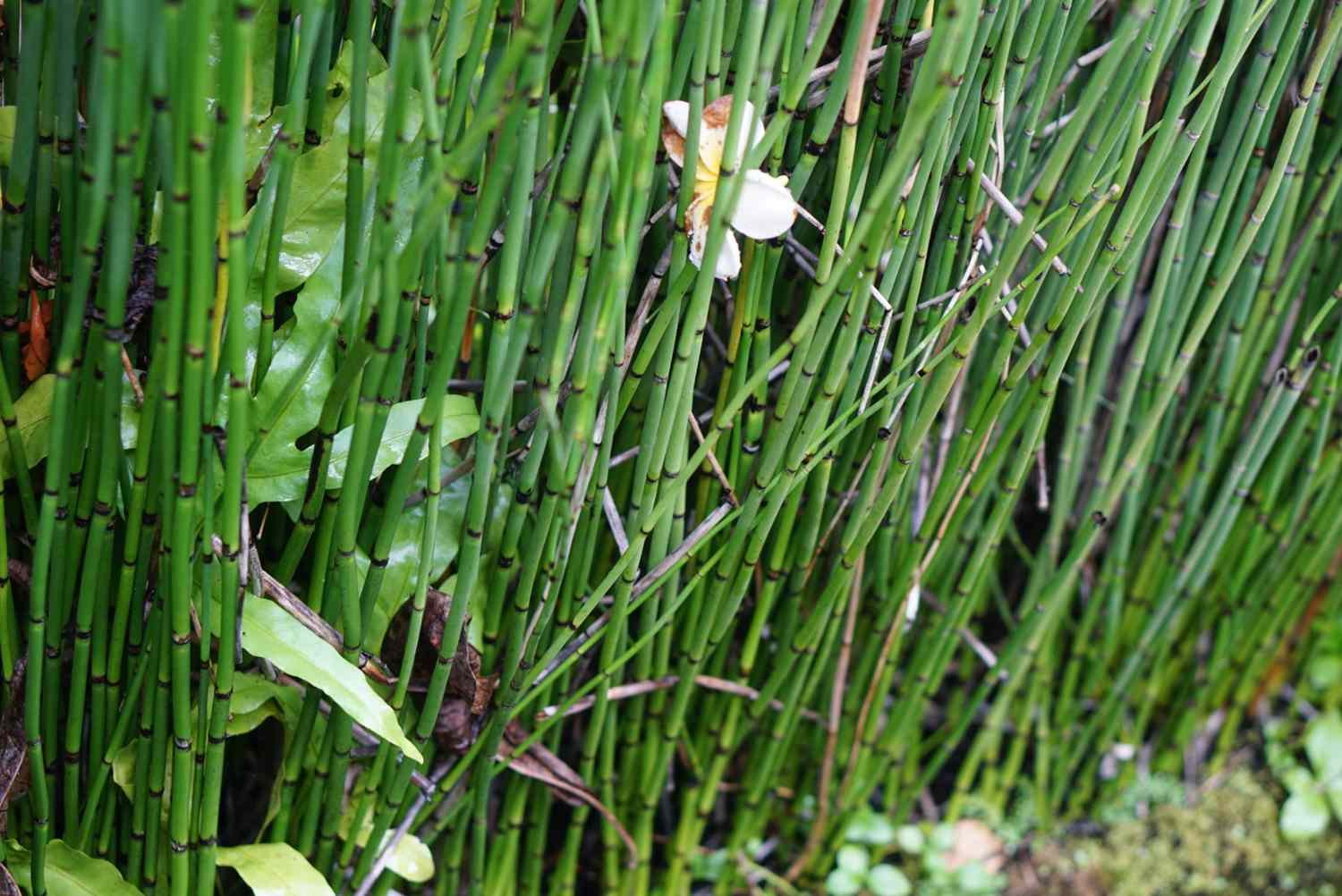
An equisetum plant is a perennial, non-flowering plant with hollow, jointed stems that grows from underground rhizomes. Commonly called horsetail, Equisetum includes plants suited to wet places, water gardens, rain gardens, and some difficult garden sites.
TL;DR
- Equisetum is a genus of perennial, spore-producing plants commonly called horsetails.
- Most Equisetum plants prefer moist soil, although species differ in their growing conditions.
- Equisetum spreads through underground rhizomes and can become difficult to remove.
- Equisetum hyemale works well in contained water gardens, while Equisetum arvense is often treated as a weed.
- Use containers or root barriers when growing an aggressive Equisetum species.
What is an Equisetum plant?
An Equisetum plant is a seedless vascular plant in the horsetail family, Equisetaceae. It does not produce flowers or seeds. Instead, it reproduces through spores and spreads through underground rhizomes. The Missouri Department of Conservation describes horsetails as perennial plants with hollow, jointed stems and small leaves joined into sheaths around each stem joint.
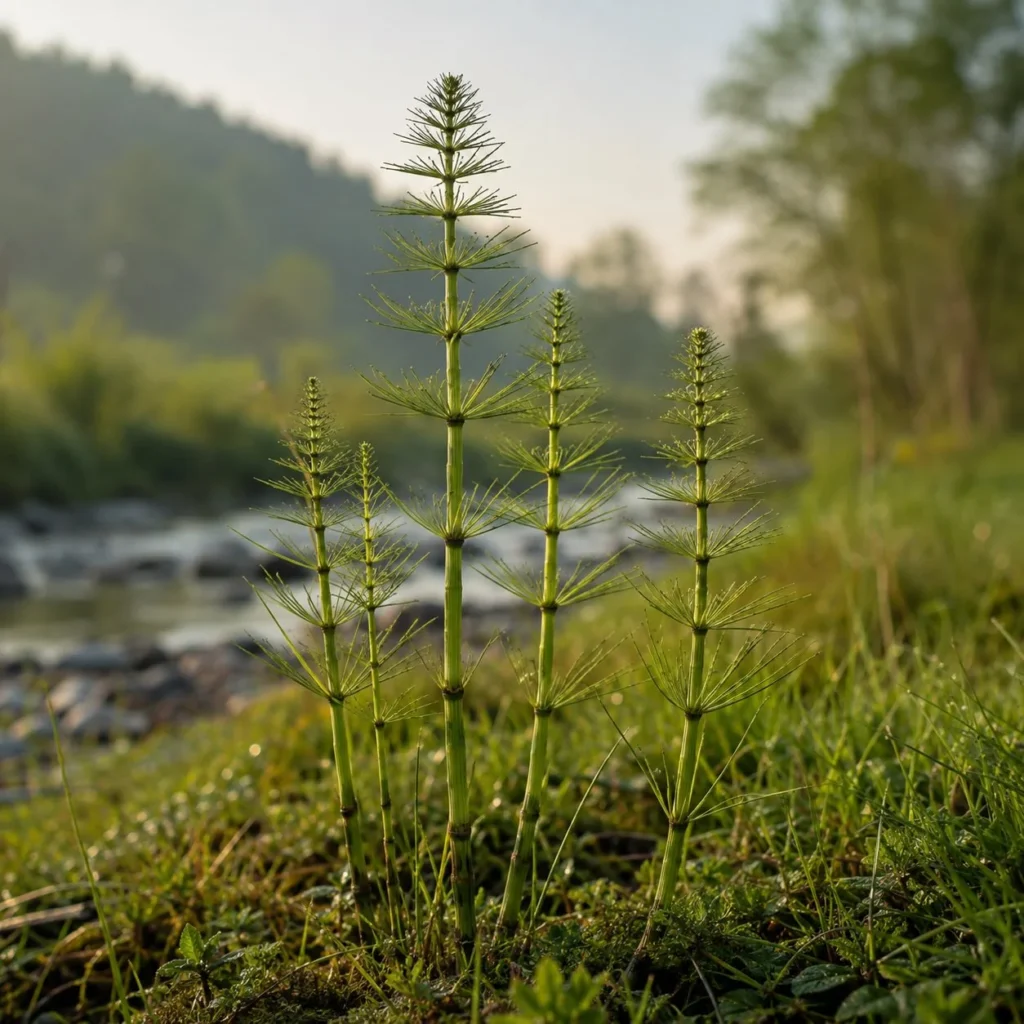
The name horsetail refers to the plant’s appearance. Some species have whorls of fine branches that give the stem a tail-like shape. Others, such as scouring rush, have mostly unbranched stems.
Equisetum is also often confused with a rush or a fern. It is neither. It is a distinct group of seedless vascular plants related to ferns and other fern allies.
Two species often encountered by gardeners are field horsetail, Equisetum arvense, and scouring rush, Equisetum hyemale. They look different and behave differently in gardens, so identifying the species before planting or removing one is useful.
How do you identify an Equisetum plant?
You can identify an Equisetum plant by its hollow, segmented stem, small scale-like leaves, and growth from underground rhizomes. The joints form clear rings around the stem, giving the plant a structure that looks somewhat like a stack of connected tubes.
Field horsetail has two distinct types of shoots. The University of Iowa’s Integrated Crop Management program describes the fertile shoots as short, pale stems that appear early in spring and carry a cone-like spore structure. Green sterile shoots appear later and have whorls of side branches.
Scouring rush looks different. Missouri Botanical Garden describes Equisetum hyemale as an evergreen perennial with rigid, hollow, vertically ridged stems and small scale-like leaves around each joint.
This difference matters because a plant that looks like a delicate horsetail in one garden may be a much more persistent species in another.
How do you care for an Equisetum plant?
Equisetum care depends on the species, but most cultivated horsetails do best when the soil stays consistently moist. Light needs also vary, although many garden forms tolerate full sun to partial shade.
For Equisetum hyemale, Missouri Botanical Garden recommends medium to wet soil and full sun to part shade. The plant can even grow in shallow standing water, making it useful around ponds and in rain gardens.
| Need | General requirement |
|---|---|
| Light | Full sun to partial shade for many garden species. |
| Water | Keep soil moist, with some species suited to standing water. |
| Soil | Moist soil is preferred by many Equisetum species. |
| Temperature | Requirements vary by species and local climate. |
| Space | Allow for spreading rhizomes or use a container. |
Avoid treating every Equisetum plant the same way. Field horsetail can grow in disturbed ground and a range of moisture conditions, while Equisetum hyemale is especially well suited to wet sites.
Does Equisetum spread aggressively?
Yes, some Equisetum species spread aggressively through underground rhizomes, and this is one of the main concerns for gardeners. The rhizomes are underground stems that can produce new shoots, allowing a colony to expand beyond the original planting area.
Missouri Botanical Garden describes Equisetum hyemale as a very aggressive spreader. Its rhizomes can spread widely and deeply, and small pieces left behind can produce new plants.
Field horsetail can also be difficult to control. North Carolina State Extension notes that Equisetum arvense develops an extensive rhizome system that can reach deep into the soil.
For this reason, plant an aggressive Equisetum species only where its spread can be contained. A large container or suitable root barrier is safer than placing it directly into an open garden bed.
Where should you grow Equisetum?
Grow Equisetum where its moisture needs and spreading habit fit the site. Suitable locations can include pond edges, bog gardens, rain gardens, wet low spots, and containers.
Equisetum hyemale is particularly useful for wet garden settings. Missouri Botanical Garden lists it for water gardens, rain gardens, bog gardens, stream and pond edges, and large patio containers.
If your soil is dry and well drained, Equisetum may be a poor choice unless you can provide the moisture the selected species requires.
Field horsetail needs a different approach. It often appears naturally in moist or poorly drained disturbed ground and can become a weed rather than a plant a gardener deliberately grows.
What should you do if Equisetum is spreading?
If Equisetum is spreading where you do not want it, avoid breaking up the rhizomes during digging or cultivation. Small pieces can produce new growth, making careless disturbance counterproductive.
Remove visible shoots repeatedly and limit further spread from the established patch. Oregon State University Extension notes that cultivation can spread field horsetail, while repeated physical removal can help reduce it over time.
For a planted Equisetum such as Equisetum hyemale, prevention is easier than removal. Grow it in a container or a contained water garden rather than allowing its rhizomes to move freely through open soil.
Do not assume that mulch alone will solve an established horsetail problem. Oregon State University Extension lists horsetail among perennial weeds that are not controlled by mulch alone.
Common mistakes with Equisetum plants
- Planting an aggressive Equisetum directly into an open bed can allow rhizomes to spread beyond the intended area.
- Treating every horsetail species as a wetland plant can lead to poor results because species differ in their preferred conditions.
- Digging through an established patch without removing rhizomes can leave pieces behind that produce new shoots.
- Confusing field horsetail with scouring rush can lead to the wrong expectations about growth and control.
Frequently asked questions about Equisetum plants
Is Equisetum a fern?
No. Equisetum is a separate group of seedless vascular plants that is related to ferns. It reproduces through spores rather than flowers and seeds.
Is Equisetum easy to grow?
Many Equisetum plants are easy to establish when their moisture and light needs are met. The harder part is controlling spread once an aggressive species becomes established.
Does Equisetum need full sun?
Not always. Equisetum hyemale grows in full sun to part shade, while individual species can differ in their light tolerance.
Can I grow Equisetum in a pot?
Yes. Growing an aggressive Equisetum species in a large container is a practical way to restrict its rhizomes. Missouri Botanical Garden specifically recommends containers for containing Equisetum hyemale.
Is Equisetum a good pond plant?
Some species are well suited to pond edges and shallow water. Equisetum hyemale can grow in standing water and is used in water gardens, but its spreading habit means containment is worth planning from the start.
Why is my Equisetum spreading?
Equisetum spreads through underground rhizomes, and some species can also reproduce through spores. An established rhizome network can produce new shoots away from the original plant.
Should I plant Equisetum directly in the ground?
Only if you have a suitable site and are prepared for its spreading habit. For aggressive species, a container or effective root barrier gives you much more control.