
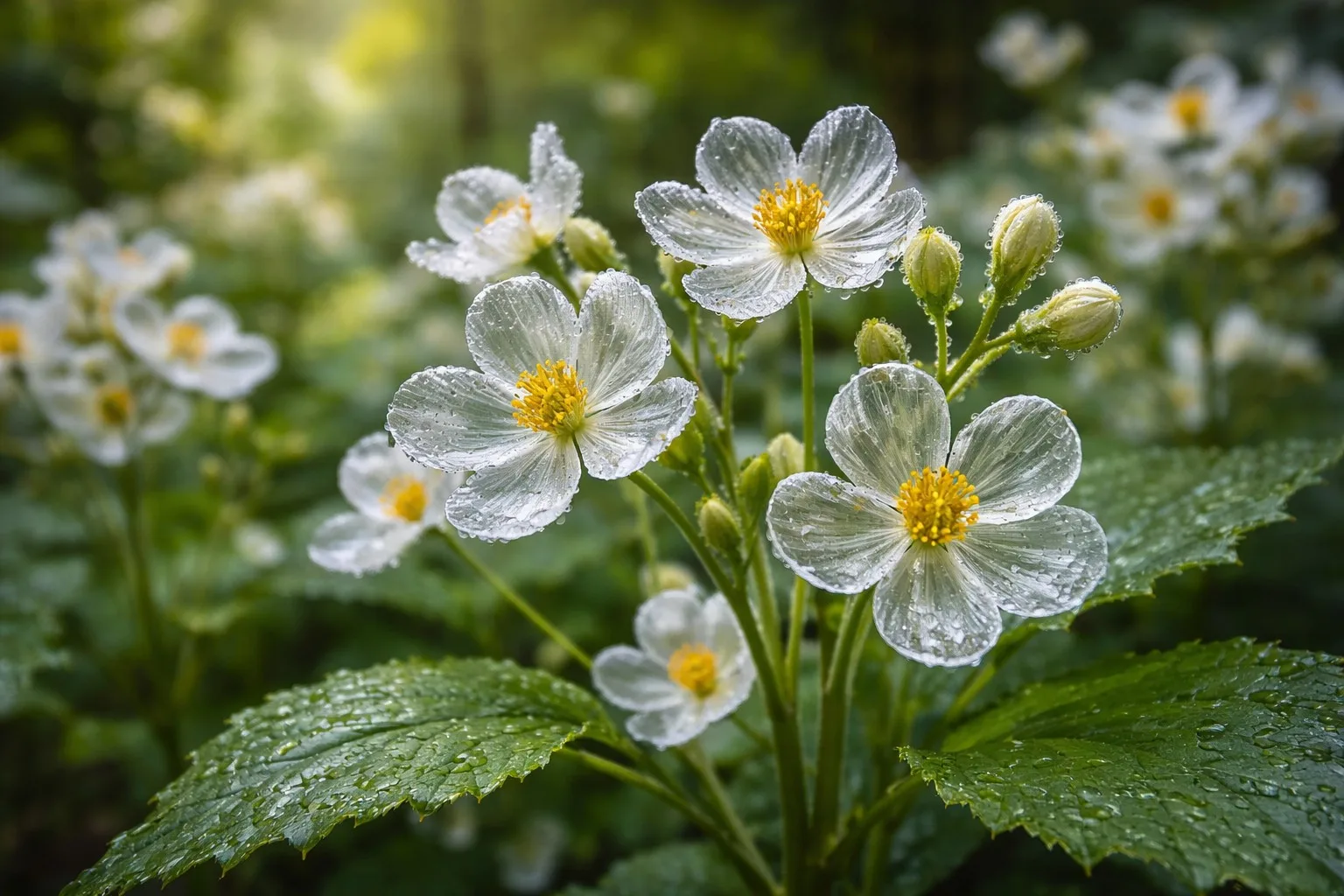
Picture this. It starts raining in your garden, and right before your eyes, the white petals of a flower slowly turn completely transparent. You can see straight through them, like glass, with just the delicate veins still visible underneath. It looks like something out of a fairy tale.
That is the skeleton flower, and it is completely real.
If you have never heard of it before, you are about to discover one of the most magical plants on the planet. This guide covers everything you need to know, whether you just want to understand what it is or actually want to grow one yourself.
What Is the Skeleton Flower?
The skeleton flower (scientific name: Diphylleia grayi) is a rare perennial plant native to the cool, shaded mountain forests of Japan and China. It grows low to the ground, reaching about 12 to 18 inches tall, with large, broad leaves that look a bit like open umbrellas.
In late spring and early summer it produces small white flowers, usually around 1 to 2 inches wide. On a dry day they look pretty but unremarkable. Then the rain comes.
When water touches the petals, they transform. The white colour disappears and they become completely see-through, showing only the delicate network of veins inside. When they dry out, they turn white again. This happens every single time it rains, throughout the plant’s blooming season.
There is no other flower quite like it in the world.
Why Do the Petals Turn Transparent?
This is the question everyone asks, and the honest answer is that scientists are still not completely certain. The leading theory is that the petals contain microscopic air pockets between their cells. On a dry day, those air pockets scatter light, which makes the petals appear white. When water fills those spaces, light passes straight through instead, making the petals transparent.
Think of it like a piece of white paper. Hold it up dry and it looks solid white. Hold it up to a strong light when wet and you can suddenly see through it. The skeleton flower works in a similar way, just far more dramatically.
What Does the Skeleton Flower Symbolise?
Because of its unusual appearance, the skeleton flower has taken on a lot of meaning in Japanese culture and beyond.
The transparency of the petals is often seen as a symbol of honesty and purity, as if the flower has nothing to hide. Its fragility and short bloom time make it a symbol of impermanence, a reminder that beautiful things do not last forever. And the dramatic transformation from white to transparent is frequently used to represent change, adaptability, and hidden depth.
For photographers, the skeleton flower has become something of an obsession. Catching those transparent petals glistening with rain drops is considered one of the most rewarding shots in nature photography.
Can You Actually Grow a Skeleton Flower?
Yes, though it does require the right conditions. The skeleton flower is not a plant you can stick anywhere and forget about. It has specific needs that reflect where it comes from: cool, shaded, moist mountain forests.
If you can give it those conditions, it is surprisingly low maintenance once it gets established.
Where to Plant It
Shade is non-negotiable. Direct sunlight will stress the plant, cause the leaves to wilt, and prevent it from thriving. A spot under trees, along a shaded fence, or in a north-facing garden bed works well.
The ideal climate is cool and temperate. Skeleton flowers grow best in USDA hardiness zones 4 to 7, which covers most of the northern United States, the UK, and northern Europe. They do not do well in hot, dry climates.
Soil
The skeleton flower needs soil that is rich, moist, and drains well. Think forest floor, that dark, spongy soil packed with decomposed leaves and organic matter. If your garden soil is heavy clay or very sandy, mix in plenty of compost before planting.
Slightly acidic to neutral soil suits it best. Avoid waterlogged ground because sitting in soggy soil will rot the roots.
A thick layer of mulch on top of the soil, such as fallen leaves or bark chips, helps lock in moisture and keeps the root zone cool. This is one of the most effective things you can do for this plant.
Watering
Keep the soil consistently moist. The skeleton flower does not like to dry out completely, especially during its growing and flowering season in spring and summer.
During dry spells, water gently and regularly. Avoid blasting the soil with a hose since that can compact it and damage the shallow roots. A gentle watering can or a slow drip works best.
And yes, the petals will turn transparent when you water them too, not just in rain. So watering it yourself is its own little magic trick.
Temperature
Cool temperatures are essential. Daytime temperatures between 50°F and 75°F (10 to 24°C) are ideal. The plant can handle cold winters well, right down to zone 4 temperatures, as long as the rhizomes (the underground root structures it grows from) are protected with a good layer of mulch.
What it cannot handle is prolonged heat. If summer temperatures regularly exceed 85°F (29°C) in your area, the skeleton flower will struggle.
Feeding
The skeleton flower is not a hungry plant. A layer of compost worked into the soil each spring is usually enough. If you want to use a fertiliser, choose one that is low in nitrogen. Too much nitrogen pushes the plant to grow lots of leaves instead of flowers.
When and How Does It Bloom?
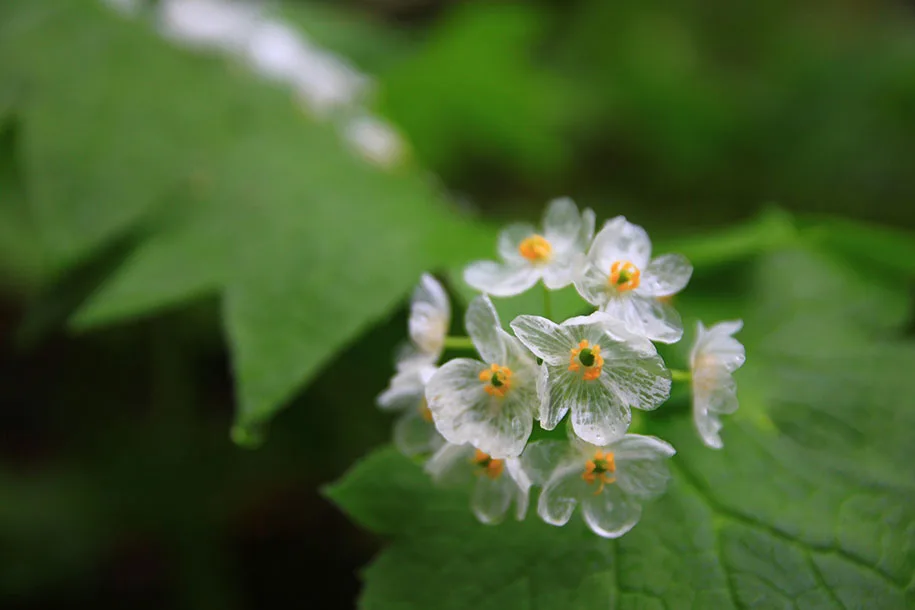
Skeleton flowers bloom in late spring to early summer, typically May and June. The flowers appear on short stems above the broad leaves, in small clusters of four-petalled white blooms.
Individual flowers do not last long, but because the plant produces multiple blooms over several weeks, you get a decent display across the season. The transparent effect is most dramatic when petals are fresh and the plant is in full bloom.
After flowering, the plant produces dark blue-purple berries on bright red stems, which are actually quite decorative in their own right and attract birds.
How to Grow More Plants
The easiest way to get more skeleton flowers is by dividing the rhizomes. In early spring or autumn, carefully dig up the plant and separate the clumps into smaller sections, each with a few healthy buds. Replant them in prepared, shaded soil and water them in gently.
Growing from seed is possible but slow and tricky. Seeds need a cold treatment called stratification, basically a period of cold and moist conditions to break dormancy, before they will germinate. Division is far easier and much faster.
Common Problems
Leaves wilting or going yellow usually means too much sun or heat. Move or shade the plant and make sure the soil is staying moist.
Slugs and snails love the broad, lush leaves. Catch them early with organic slug pellets or by picking them off by hand in the evening.
Root rot happens when the soil stays waterlogged. Improve drainage by adding compost or grit to the soil, and avoid overwatering.
No flowers after a couple of years usually points to too much shade, a very young plant, or soil that is too poor. Add compost and make sure the plant is not in complete darkness.
Frequently Asked Questions
Do I need a big garden to grow skeleton flowers? Not at all. They work beautifully in large pots kept in a cool, shaded spot. Just make sure the pot drains well and you keep the soil moist.
Will the petals really turn transparent every time it rains? Yes, every single time. And they go back to white when they dry. It never gets old.
How long does it take to establish? Skeleton flowers are slow to get going. Give them two to three years to settle in and start flowering reliably.
Are they safe around children and pets? The berries produced after flowering are not edible and should not be eaten. Keep curious pets and young children away from the berries to be safe.
Where can I buy one? Skeleton flowers are rare in regular garden centres. Look for specialist plant nurseries, woodland garden suppliers, or reputable online plant shops. They are worth the hunt.
Final Thoughts
The skeleton flower is proof that nature is far more creative than anything we could dream up. A flower that turns transparent in the rain, found growing quietly in mountain forests, patiently waiting for anyone curious enough to seek it out.
It takes a bit of effort to grow well. It needs shade, cool temperatures, moist soil, and some patience while it establishes. But once it is settled in and that first rainy day arrives, you will be very glad you made the effort.
There are very few moments in gardening quite as rewarding as watching those petals disappear.