
The dandelion plant life cycle starts with a seed and moves through germination, leaf and root growth, flowering, seed formation, and seed dispersal. Because dandelions are perennial plants, the same root system can also produce new growth in later seasons.
TL;DR
- Dandelions begin life as seeds that germinate and form a small leaf rosette.
- The young plant develops a deep taproot and a larger rosette before flowering.
- Yellow flower heads rise on hollow stalks above the leaves.
- After flowering, each seed develops a feathery structure that helps wind carry it away.
- The plant remains perennial, so its root can support new growth in another season.
What are the stages of the dandelion plant life cycle?
The dandelion plant life cycle has five simple stages: seed, germination, rosette growth, flowering, and seed dispersal. The plant then remains alive as a perennial and can begin another cycle when conditions allow.
Common dandelion, Taraxacum officinale, is a perennial herb with a basal rosette of leaves and a thick taproot. The leaves grow close to the ground, while the flowers appear on separate, leafless stalks.
The cycle is easy to picture as a loop rather than a straight line. A seed grows into a plant, the plant produces flowers and seeds, and those seeds start new plants.
How does a dandelion seed germinate?
A dandelion seed germinates when moisture and suitable growing conditions allow the seed to begin developing. The young seedling first produces small leaves, then develops the characteristic rosette that stays close to the soil.
Dandelion seeds are small and have a feathery pappus, the tuft that looks like a tiny parachute. This structure helps mature seeds move through the air.
Once established, the young plant puts energy into its leaves and root. The developing taproot gives the plant a strong underground storage structure and helps explain why established dandelions can return after the foliage is removed.
How does a dandelion grow before flowering?
Before flowering, a dandelion grows as a low rosette of leaves while its taproot develops below the soil. The leaves are deeply lobed and usually point toward the plant’s center, making the young plant easy to recognize.
During this stage, the plant builds the leaf and root growth needed for flowering. Dandelions can grow in many disturbed places, including lawns, paths, open ground, and other sunny sites.
The exact timing varies with weather and location. In many regions, dandelions can flower in spring and again later in the growing season, so a plant may move through the cycle more than once during a favorable year.
What happens when a dandelion flowers?
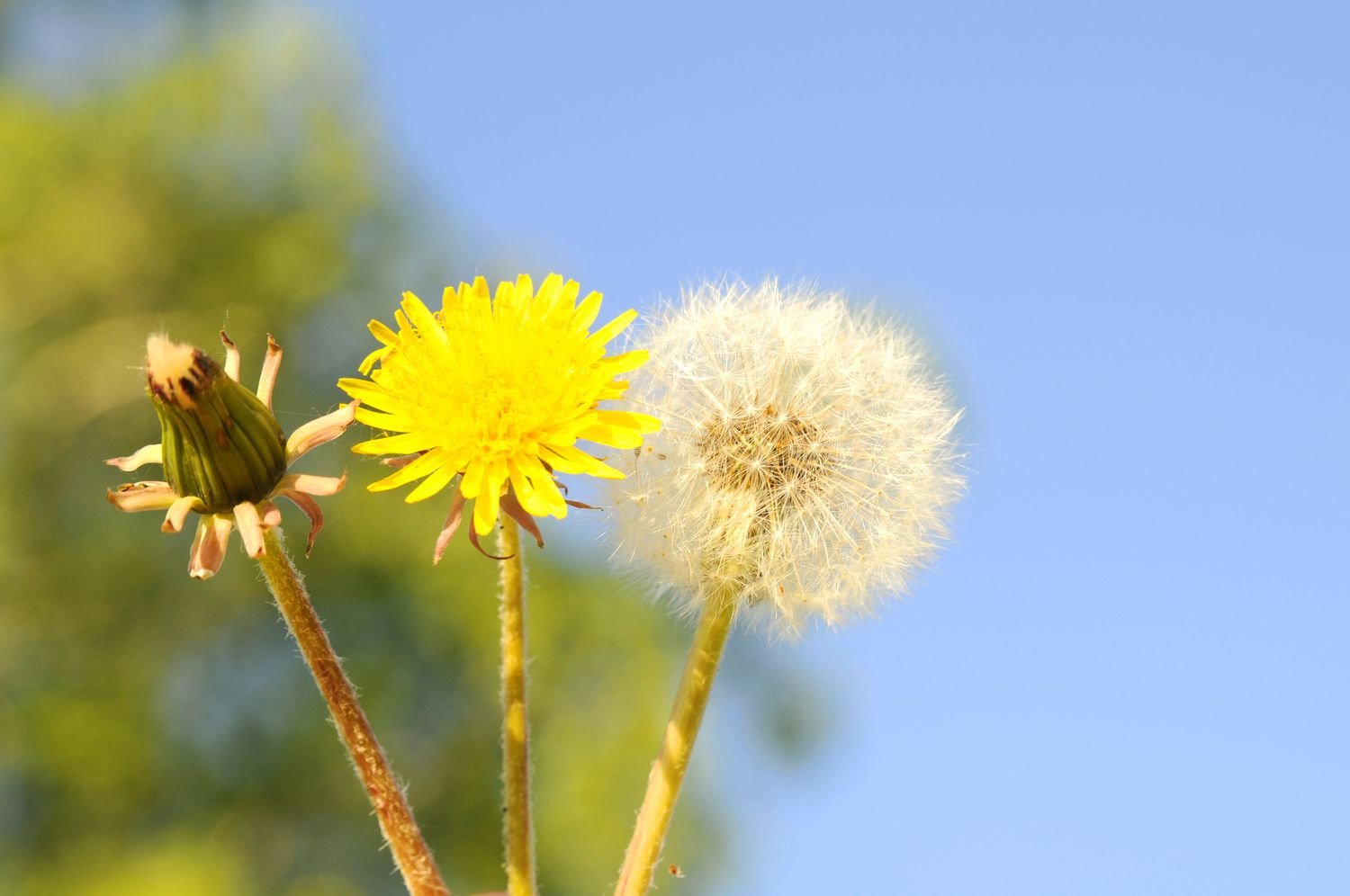
A flowering dandelion produces a yellow flower head on a hollow stalk that rises above the leaves. What looks like one flower is actually a flower head made up of many small flowers.
The flower head opens in suitable conditions and later closes as the plant moves toward seed production. After flowering, the head changes into the familiar white seed ball.
The United States Forest Service describes common dandelion as a cool-season perennial and reports flowering from spring into fall in many parts of the United States, with flowering possible year-round in warmer areas. Timing varies by climate and local conditions.
How does a dandelion turn into a seed head?
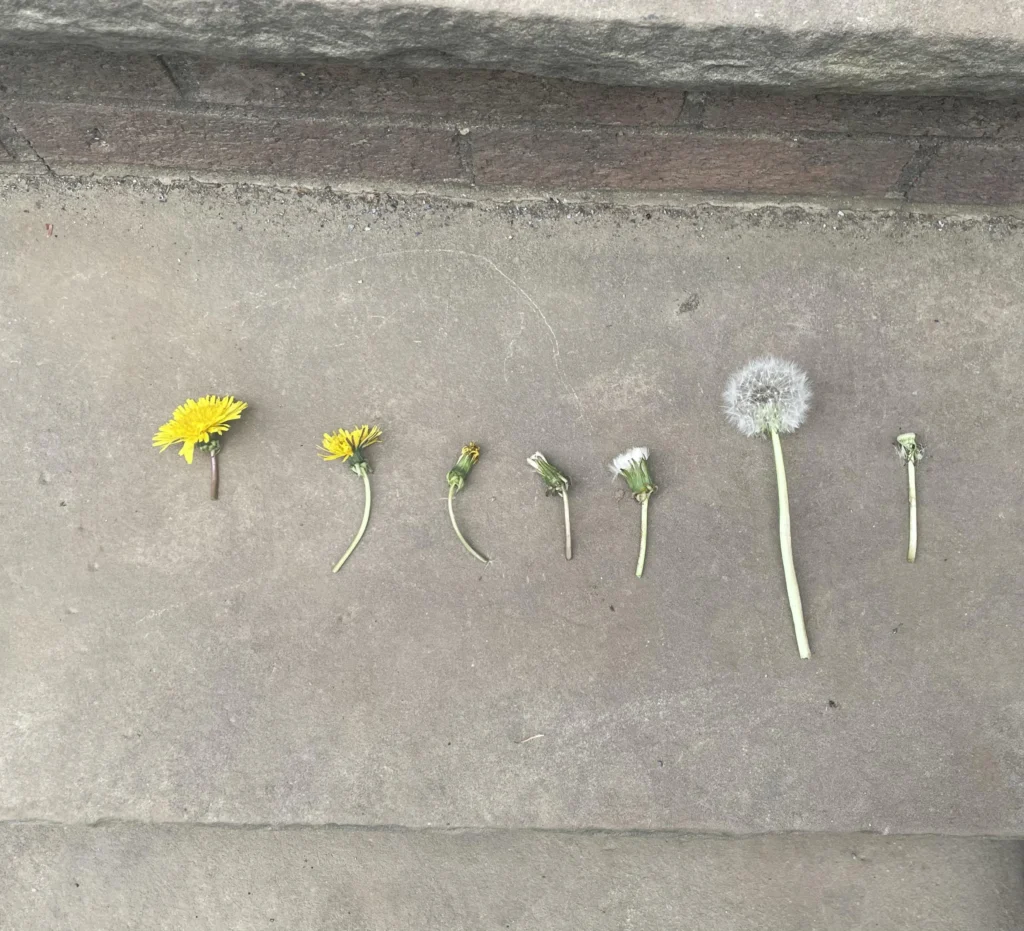
After flowering, the dandelion develops dry fruits called achenes. Each achene is attached to a feathery pappus, creating the familiar white seed head that can carry seeds on the wind.
The seed head is an efficient way for dandelions to spread. When the mature head is disturbed by wind or movement, individual seeds can separate and travel away from the parent plant.
Penn State Extension notes that dandelions produce seeds without pollination and that each seed is contained in an achene attached to a feathery pappus.
How do dandelion seeds spread?
Dandelion seeds spread mainly through wind. The feathery pappus acts like a small parachute, allowing the lightweight seed to travel before landing on suitable soil.
This explains why dandelions can appear some distance from an existing plant. The United States Forest Service reports that common dandelion seeds can travel considerable distances with the help of their parachute-like pappus.
After a seed lands, the cycle can begin again. If moisture, temperature, light, and soil conditions are suitable, the seed can germinate and produce another rosette.
What happens to the dandelion after seed dispersal?
The dandelion does not necessarily die after producing seeds because it is a perennial plant. Its root and growing point can remain in the soil and support new leaves and flowers during another favorable period.
This is one reason an established dandelion can return after flowering or after its leaves are cut. Removing the visible leaves does not always remove the underground root system.
The University of Minnesota Extension describes dandelion as a perennial that maintains a basal rosette and has a fleshy taproot.
Why can dandelions repeat their life cycle so often?
Dandelions can repeat their life cycle because the plant combines perennial growth with abundant seed production. The root system can support regrowth, while the flowers produce many seeds that can spread to new locations.
The United States Forest Service describes common dandelion as a perennial and notes that it reproduces mainly from seed. It also reports that the species can maintain a long-lived seed bank in soil.
For gardeners, this means one dandelion can be part of several overlapping generations. A mature plant may produce seeds while other dandelion seeds from earlier seasons are still present in the soil.
Common questions about the dandelion plant life cycle
How long does the dandelion plant life cycle take?
There is no single timeline because flowering and seed production depend on climate, weather, and growing conditions. Dandelions can complete the seed-to-seed portion of the cycle during a favorable growing period while the parent plant remains perennial.
Do dandelions come back every year?
Yes. Common dandelion is a perennial, so an established plant can survive from one season to another and produce new growth.
What happens after a dandelion flower turns white?
The yellow flower head develops into a seed head made of many small, feathery seed structures. Wind can then carry the seeds to new locations.
Can dandelions grow from their roots?
Dandelions can regrow from their underground perennial structure after the foliage is disturbed. A remaining root system can support new growth.
When do dandelions flower?
Dandelions often flower in spring, but flowering can continue into fall in many regions. In warmer climates, flowering can occur during much of the year.