
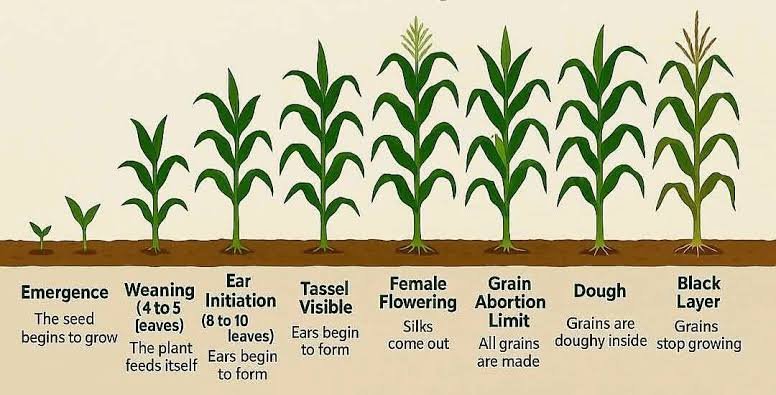
Corn plant growth stages describe how a corn plant develops from a seedling into a mature plant with fully developed kernels. The standard system divides development into vegetative stages, marked with V, and reproductive stages, marked with R. Knowing these stages helps you identify what the plant is doing and when changes such as tasseling, silking, kernel formation, and maturity occur.
TL;DR
- Corn growth starts at VE, when the shoot emerges from the soil.
- Vegetative stages run from V1 through the final leaf stage and VT, when the tassel becomes visible.
- Reproductive stages run from R1, when silks appear, through R6, physiological maturity.
- V stages are identified mainly by counting visible leaf collars.
- R stages are identified by changes in the kernels, from blister and milk to dough, dent, and physiological maturity.
How corn plant growth stages are identified
Corn plant growth stages are identified by visible changes in the plant. During the vegetative period, the number after the V refers to the number of leaves with visible collars. During the reproductive period, the R stages describe changes in the ear and kernels.
A leaf collar is the lighter-colored band where the leaf blade and leaf sheath meet. Once a collar is visible, that leaf counts toward the plant’s vegetative stage.
For example, a corn plant with three visible leaf collars is at V3. The system continues through the vegetative stages until VT, when the lowest branch of the tassel becomes visible.
The reproductive stages begin at R1, when silks extend outside the husks. The stages then progress according to kernel development until R6, when the kernels have reached physiological maturity.
The vegetative stages: VE through VT
The vegetative period begins at emergence and continues as the plant produces leaves, expands its root system, and develops the structures that will eventually produce the ear and tassel.
VE: emergence
VE means emergence. At this point, the young shoot, protected by the coleoptile, has emerged from the soil.
The plant is still small, but early growth sets the foundation for later development. Soil temperature, moisture, planting depth, and seed condition can all affect how quickly seedlings emerge.
V1 and V2: the first leaves
At V1, the first leaf has a visible collar. That first leaf has a rounded tip, which helps distinguish it from the later leaves.
At V2, two leaves have visible collars.
From this point forward, the number after the V generally tells you how many leaves have visible collars. So V5 means five leaves have reached the collar stage.
V3 through the later vegetative stages
From V3 onward, corn rapidly produces additional leaves. The plant becomes taller, the root system expands, and the growing point eventually moves above the soil surface.
You don’t need to memorize every V stage to understand corn development. For practical identification, count the visible collars and use that number as the stage.
The exact number of vegetative stages varies with the corn hybrid and growing conditions. Temperature, water availability, nutrients, and hybrid maturity can change how quickly the plant moves from one stage to another.
VT: tasseling
VT is the tasseling stage. The lowest branch of the tassel is visible at the top of the plant.
VT marks the end of the vegetative staging system. The next major stage is R1, when silks become visible outside the husks.
VT and R1 can occur close together, so don’t assume that a visible tassel means the plant has already reached R1. Look for silks when identifying the reproductive stage.
The reproductive stages: R1 through R6
The reproductive stages describe pollination, kernel development, grain filling, and maturity. These stages are especially useful when checking how the ears and kernels are developing.
R1: silking
R1 is the silking stage. One or more silks have emerged from the husks.
Silks are part of the female flower of the corn plant. Pollen from the tassel lands on the silks, allowing fertilization to occur.
R1 is an important transition because the plant is moving from producing leaves toward developing and filling kernels.
R2: blister
R2 is the blister stage. The kernels are small and resemble clear blisters when examined closely.
The kernels contain clear fluid at this stage. Development continues as the plant begins accumulating more material inside each kernel.
R3: milk
R3 is the milk stage. The kernels contain a milky fluid as starch begins accumulating.
If you carefully examine a developing kernel at this stage, the contents are soft and liquid rather than solid. Kernel development is well underway, but the grain has not reached maturity.
R4: dough
R4 is the dough stage. The fluid inside the kernels becomes thicker and develops a dough-like consistency.
Starch accumulation continues during this stage. The kernels are becoming more solid as they move toward the dent stage.
R5: dent
R5 is the dent stage. A visible indentation develops at the top of the kernels.
A milk line can also be seen moving toward the base of the kernel as the kernel dries and starch continues to accumulate. The progression through R5 can take time, so a field may remain in the dent stage while the kernels continue developing.
R6: physiological maturity
R6 is physiological maturity. The kernels have reached their maximum dry matter accumulation, and a black layer forms at the base of the kernels.
At this point, the kernels have completed their main period of dry matter accumulation. The plant may still lose moisture after R6, but kernel development has reached physiological maturity.
How long does each corn growth stage take?
There isn’t one fixed number of days for every corn plant growth stage. Development depends on temperature, water availability, nutrients, hybrid maturity, and local growing conditions.
Temperature is particularly important. Corn development is often tracked using growing degree days, which measure accumulated heat rather than simply counting calendar days. This makes heat-based tracking more useful when comparing development under different weather conditions.
For the same reason, a calendar such as “corn reaches silking on a certain day” can be misleading. Two fields planted at different times or growing under different temperatures may reach the same stage on different dates.
When identifying corn growth stages, the plant’s visible characteristics are more reliable than a fixed calendar schedule.
Why knowing corn growth stages matters
Growth stages help you understand what is happening inside the plant and when environmental stress may affect development.
For example, the plant’s needs and responses change as it moves from early vegetative growth into tasseling, pollination, and kernel development. Water stress, heat, frost, insects, disease, and other problems can have different effects depending on when they occur.
Growth stages are also used to describe crop-management timing. If a product label gives a maximum corn growth stage for an application, you need to identify the plant’s actual stage rather than relying on the number of days since planting.
For home growers, the same system gives you a simple way to describe what your corn is doing. Instead of saying that the plants are “pretty tall,” you can identify whether they are around V4, approaching VT, silking at R1, or filling kernels at R3.
Common mistakes when identifying corn growth stages
One common mistake is counting every visible leaf as a V stage. The standard collar method counts leaves with visible collars, not simply leaves that can be seen.
Another mistake is confusing tasseling with silking. VT means the tassel has reached the defined tasseling stage. R1 begins when silks are visible outside the husks.
It’s also easy to assume that corn reaches each stage after a fixed number of days. Weather and hybrid characteristics can change development speed, so visual signs provide a better way to confirm the stage.
Finally, remember that growth-stage terminology describes development. It doesn’t tell you by itself whether a plant is healthy. A corn plant can be at the same growth stage as its neighbors while experiencing different levels of drought, nutrient, pest, or disease stress.
Frequently asked questions about corn plant growth stages
What are the main corn plant growth stages?
Corn growth stages are divided into vegetative stages, from VE through VT, and reproductive stages, from R1 through R6. The vegetative stages track leaf development, while the reproductive stages track tasseling, silking, kernel development, and maturity.
What does VE mean in corn?
VE means emergence. It is the stage when the corn shoot has emerged from the soil.
What does V6 mean in corn?
V6 means six leaves have reached the defined vegetative staging point. With the collar method, this means six leaves have visible collars.
What does VT mean in corn?
VT is the tasseling stage. The lowest branch of the tassel is visible, marking the end of the vegetative stages.
What does R1 mean in corn?
R1 is the silking stage. One or more silks have emerged from the husks, marking the beginning of the reproductive stages.
What is the difference between R5 and R6 corn?
R5 is the dent stage, when kernels develop a visible dent and continue accumulating dry matter. R6 is physiological maturity, when kernel dry matter accumulation is complete and a black layer forms at the kernel base.